THE JUNGLE CAST BLOG POST

Upton Sinclair describes Ona as small or petite especially in comparison to her husband but even in general she is small. She is smart and feminine. So no casting ideas automatically came to my mind at first. No actresses clicked so I went on google images and typed in petite Lithuanian women 1900s but nothing really caught my eye. I had typed in Lithuanian of course because that’s what Ona was but then I just searched up petite women 1900s and came across the photo the I would use. This photo just isn’t a random photo. The women’s name is Della Moore(also goes by Annie rogers and/or Maude Williams) and she was actually around during the old west and was the girlfriend of an outlaw named Harvey Logan. I picked her because she did look petite and also looked like she could pull that small side of Ona as described. For Jurgis unlike with Ona a name did actually come up to mind. Upton Sinclair describes him as big and strong, just like how Ona was the more traditional women Jurgis was the more traditional man. In my head I imagined someone I could see working hard physical labor jobs, someone who was physically big but not huge in like a body builder or wrestler type of way. Pedro Pascal came to mind as he is in a show I’ve been watching called The Last Of Us and in that show I think he fits the Jurgis role perfectly  since it looks like he bulked up especially compared to his other roles in other works.

Casting of Ona and Jurgis

Saoirse Ronan as Ona
Jason Momoa as Jurgis

For my casting I tried to stay true to the depictions of the characters in the novel. For Ona, I think young Saoirse Ronan would have been a good actress to play her part since she fits the description of Ona’s age and probably her appearance. Though not too much information is given about her physically, I imagine her being small and frail especially compared to Jurgis. I also wanted there to be a significant age gap between the characters casted since there is a significant age gap between Ona and Jurgis which seems relevant to the time period in which the story takes place. For example, the text states that Ona’s father was concerned about letting Jurgis marry his daughter because “the girl was yet a child.” When talking about the people in Ona’s family, it is also stated that it consisted of there being “twelve in all the party, five adults and six children— and Ona who was a little of both.” Since the actors (Saoirse Ronan and Jason Momoa) have an age gap of 15 years I thought it would represent Ona and Jurgis well. As for Jason Momoa being casted as Jurgis, I think this works because both are tall and have a “manly” build. Jason is 6’4 and his role as Aquaman makes me think of him as this super strong, powerful guy who wants to be the hero just like Jurgis wants to be the hero in bringing his family to success. Physically speaking he is also very strong and muscular as suggested by the lines “Do you want me to believe that with these arms”⁠—and he would clench his fists and hold them up in the air, so that you might see the rolling muscles⁠— “that with these arms people will ever let me starve?” Overall I think sticking to a close adaptation of the novel is what I would lean towards since I always enjoy book adaptations best when they stay true to what the writing says and the way the characters are portrayed.

Wedding

Jurgis and Ona
Jurgis and Ona
Wedding
Wedding

“Most fearful they are to contemplate, the expenses of this entertainment. They will certainly be over two hundred dollars and may be three hundred, and three hundred dollars is more than the year’s income of many a person in this room(Jungle).” I attached these photos to contrast the worried protagonist hiding behind the happy wedding scene and the audience leaving without paying. Many guests take advantage of the families of the newlyweds at these celebrations, however, filling themselves with food and drink and leaving without contributing any money. Some leave with open contempt while others sneak away. Bartenders even tricked their families into saying they consumed more than they were supposed to. When Ona notices that many guests are departing without paying, she gets concerned about the expense of the ceremony, but Jurgis assures her that they will find a way to pay the bill. He promises to just work harder and make more money.

The book Jungle is a book that criticizes capitalism at the time, and you can indirectly feel the corruption of people at the time just by looking at the wedding situation, the first introduction. So, I put the pleasant photos as the author intended, but I think it would be more fun to make a movie by maximizing the harsh reality and the situation of the wedding hall in contrast with the photos in reality. I think it would be more impressive to the people who watch my movie if I describe photos and situations that are opposite to the actual situation at the time and tell a story that reflects reality.

My Close Adaptation of The Jungle

Arnold Schwarzenegger posing as a bodybuilder in the late 60s.
Black and white picture of Winona Ryder in the 80s.

I picked these actors mainly because of my familiarity with them and how they match most of the prominent physical traits of the characters. The text states, “Ona was blue-eyed and fair, while Jurgis had great black eyes with beetling brows, and thick black hair that curled in waves about his ears⁠—in short, they were one of those incongruous and impossible married couples with which Mother Nature so often wills to confound all prophets, before and after.”

First, Jurgis’ main qualities come from his physical appearance as Upton Sinclair doesn’t fail to remind the audience how big and brawn Jurgis is, mentioning the size of his hands, muscles and facial features in grand ways. As you all can see, Arnold Schwarzenegger is definitely a huge man especially in his body builder days. Also, he is over 6 feet tall, caucasian and is best known for playing the role of indestructible terminator which for some reason reminds me of Jurgis as he has a sort of Lenny energy from Of Mice and Men as it feels he could crush something with his bare hands.  

Next, I picked Winona Ryder for many reasons. Although she doesn’t have blue eyes, she is very fair and small as she is only 5’3”. I also grew up watching her films and admire her work as I feel she does a great job at portraying strong emotions. Sinclair refers to Ona as small Ona many times as well as alluding to her fragility as she is kind and tends to live in her head from time to time. In comparison to Schwarzenegger I believe the size difference would be a bit comedic as Jurgis and Ona as one strong with sharp features and one dainty and elegant. Obviously, I chose to do a close adaptation mainly because from time to time it can be hard for me to reimagine characters I have already formed a picture for. I hope you all enjoyed my choice of actors for a  movie adaption of the Jungle. 


Fantasy Casting of The Jungle

Dreamy dreamer Jurgis.
In this adaptation, Ona is ripped.

Jurgis is physically strong and has “thick black hair that curled in waves” and thick eyebrows (Sinclair, Chapter 1). He is young and gigantic (Sinclair, Chapter 2 first page). Because his Lithuanian roots are important to his character and to the story, it may be important to consider reflecting this in our casting. Jurgis is a bit of a contradictory character between appearance and vibe. (slight spoiler alert) I know that despite having strength and strong features, he is beaten down by the brutal life of a meat packing worker. He has lots of energy and enthusiasm and confidence in the American dream, but ultimately he is exploited. In summary, Jurgis is a Lithuanian with strong, dark features and he is a dreamer to be disillusioned through the course of our film. My choice for this role is a young Sean Penn. Dark curly hair, strong eyebrows, Lithuanian roots, and both a sense of energy and also seriousness to take on the disillusionment arc of Jurgis. He may not have the “mighty shoulders and […] giant hands” of Jurgis, but I think he can still convey toughness in his performances (Sinclair, Chapter 1). As Ona is not the protagonist, we get just a bit less information about her appearance and personality. She is feminine, petite, blue-eyed and fair–in contrast to Jurgis physically. She is loving, dutiful, and responsible. She is described as “One of God’s gentlest creatures”, but this is my movie and in my movie she is a tough, muscular woman (Sinclair, Chapter 1). Not sure if she has Lithuanian or immigrant roots, which may pose problems; however, Emily Blunt can both act as a good counterpart to young Sean Penn with her light features, while also being fittingly gritty for the setting of the film. At the time, Sinclair’s use of hyper feminized and hyper masculinized tropes may have been very effective in his muckraking 100 years ago, but I do not think these archetypes are necessary in my fantasy casting in 2023.

Winning NYC Muckraking Novel: “The Conductor” and in second place “What Do You See?”

Dear All,

Excellent work today. The winners of 2pts to their overall participation grade are

The Conductor, Book One: Jotham Series

by Kevin, Hudson, Amy, Carty

Hand drawn novel cover. Top center says Book One:Jotham Series, underneath a green mask, center a subway train with a "J" and at eh bottom the title "The Conductor"


Handwritten notes and plot points for The Conductor, an NYC muckraking novel


***

A close second place goes to

What Do You See?

by Kenia, Ganna, and Natalia

Top of page title "What do you see?" above a university building with a Rorschach ink block with a graduation cap on it.

What Do You See? Handwritten notes for a NYC Muckraking Novel

ALL participants in class will receive .5+ added to their “Participation” grade

Other intriguing novels designed in class include:

Ah, Rats! Take a Chance

by Ahmed, Michael, and Amara

Top left, a flying rat with red eye and wings, center a larger red eyed rat eating a 6 subway train and a yellow caution line on a subway platform

Handwritten notes for Ah Rats! Take a Chance, a NYC Muckraking novel

Swipe

by Sophia, Junhyeok, and Marco

Center the title "swipe" underneath a detailed hand drawn metro card melting on one corner with a burn

Handwritten notes for Swipe A NYC Muckraking Novel

Tutorial and Rubrics for Instructor Assessment of Comments and Blog Posts

The rubric for comments:

To post a comment reply, click on the post, scroll down to the bottom where it says “Leave a Reply” in bold, fill out the “Comment Box,” and click “Post Comment.”

Note: Wi-fi can be a bit tricky, so make sure you are in a place where the signal is strong enough to post.

Rubric for Comments

The rubric for blog posts

Rubric for Blog Posts pdf

A  5 min video showing you how to create a Blog Post

In Class Activity: Getting to Know You/ Class Scheduling Worksheet (Jan 31st)

Dear All,

To plan class activities (ungraded but “exit” tickets/often count as a record of attendance and participation) and class trips, I need a little more information from you. Please fill out the  google form linked here, “Getting to Know You Google Form.” It should take 5-10 mins. We will spend the first part of class on Jan 31 completing this form.

Warmly,

ER


How to Record yourself with Zoom (for “Welcome to the Week)

One of the options for “Welcome to the Week” is is use Zoom to record yourself or your screen using google slides or both.

Here are directions from the Zoom site, linked here “Enabling and starting local recordings”

Directions:

Local recording is available to free and paid subscribers. Local recording allows participants to record meeting video and audio locally to a computer. Local recordings can include participant names, separate audio tracks for each participant, timestamps, and other options. Local recordings capture the meeting as the participant recording sees the meeting, meaning the recording will capture the meeting in speaker view, if that is what video layout is currently in use.

You can upload recorded files to a file storage service such as Dropbox, Google Drive, or a streaming service like YouTube or Vimeo. Local recording files can be found in the default Zoom recording folder on your system.

Prerequisites for local recordings

  • Basic (Free) account or above
  • Zoom desktop client for Windows, macOS, or Linux: Global minimum version or higher

Note: Local recording is not supported on iOS, iPad, or Android devices. See cloud recording for paid accounts if you are using a mobile device.

How to start a local recording

The host must record the meeting or grant the ability to record to a participant.

  1. Start a Zoom meeting as the host.
  2. Click Record .
  3. If there is a menu, select Record on this Computer.
    Hosts will see the following recording indicator in the top-left corner while recording is active.

    Participants will see the following indicator in the top-left corner while the recording is active.
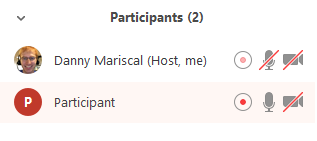
  4. Click Participants to see which participants are currently recording.

    Note: Dial-in participants will hear a message informing them that the meeting is now being recorded unless disabled by the host.
  5. After the meeting has ended, Zoom will convert the recording so you can access the files.
  6. Once the conversion process is complete, the folder containing the recording files will open.
    Note: By default, the recording files are formatted a certain way. The audio/video file (MP4) will be named video[random number].mp4. The audio only file (M4A) is named audio[random number].m4a.

Note: 

  • If the meeting unexpectedly shuts down or if the conversion process is interrupted, the recording files could become corrupted and non-recoverable. Restarting or shutting down your computer, putting the hard disk to sleep, or closing your laptop will interrupt the conversion process.
  • If the conversion process is not successful after the meeting has ended, you can try to manually convert the recording.
  • You can record the meeting in different layouts including Active Speaker, Gallery View, and shared screen.
  • After the file has completed converting, if you choose to rename the file from the default naming convention, we recommend you use a unique file name. We recommend you do not use the words Zoom, Personal Meeting Room, or My Meeting when saving your meeting files.

“Expectations and Rubric for Welcome to the Week” 

Greetings!

Below is a rubric for the “Welcome to the Week” presentation/leading discussion blog post/video. Each student will do ONE. This is worth 10% of your grade. This is regarded as a “larger” assignment along with the 2 critical analysis papers.

Main Goal and Point of this Assessment:

To provide a foundation and motivation to engage the material. What does that mean? “foundation” are your passages, contemporary parallels, links, and resources. Your questions and explanation of your own curiosity and thinking will further motivate the class.

There are items to check off in terms of form and content detailed below, but you want to think more about how you can select quotes and related sources and word questions (your question may have an explanation or levels.)

Form

Add a category

Each video should be embedded in a blog post so that peers can make comment replies on our class site and so that material is archived in a centralized location

Provide a title that informs which week and text is your focus.

Include the category (metadata that you must add). On the right-hand side of the blog post, composition page there is a box that says “Categories.” Pick “Welcome to the Week” so that it automatically be found under the “Welcome to the Week” menu heading. You may also choose to add your own phrases and words associated with your post in the “Tags” box.

Word Count/ Length

Each post should have a video: 5-10 mins long Or 300-800* words. If you write your post, be sure to break down topics and points of focus with subtitles or subheadings to help guide our reading of your post.

*I extended the word count if needed. The word count DOES NOT include passages. Remember, the goal is not “how much do I have” but “how well did I provide a foundation and motivation to engage”?

Content

Questions

Pose at least 3 questions for peers to respond to in their comment replies

Passages

Include 2 passages (you can read them out loud or just post and describe them)

Cultural content, contemporary parallels, media, and images are welcome (if you are uncertain about how to add these materials, check out the “How to Guides and Tutorials” page in the menu)

Try to cite and link as much content as possible (this will help when it comes time to write larger assessments).

In class, you will be invited to reflect (e.g. speak for 1-2 mins) on your post before I go through the comments

Real Talk about Time management

It took me an hour and 1/2 to read, 1/2 hour to create my slides and video, an hour to edit the video, and a final 15 mins to upload and post. That’s 3 hours and 15 mins.  You may not have to edit the same amount as I did, but this is a larger assignment that takes time. Be sure to schedule tasks.

If you want to create a video, here is a link to a blog post with advice and directions for creating a video blog, but you can take your own approach. Just avoid trying to upload a video to the “media library” on this site because if there is too much data, it will run out of room, and I will need to request more.

Assessment (Grade form instructor provided on Blackboard)

  1. Post  one 5-10 mins Youtube video embedded in a blog post posted to this CUNY Commons site OR a blog post with a  word count of 300-800 (50 points)
  2. Category, titles, and subheadings (if needed) (5 points)
  3. 3 questions (30 points)
  4. 2 passages (10 points)
  5. Media, Links, citations (5 points)